Skip to content
Starting an IVF journey is a deeply personal decision filled with hope, patience, and careful planning. One of the most common questions couples ask before beginning treatment is: “What are the IVF success rates in Turkey by age?” Understanding these statistics helps set realistic expectations and guides you in making informed decisions about where and when to start your journey. Turkey, known for its advanced fertility clinics, internationally trained specialists, and affordable costs, has become a top destination for assisted reproductive treatments. However, just like anywhere else in the world, age remains the single most influential factor in determining IVF success rates in Turkey.
Table of Contents
A Statistical Look at Turkish IVF Success Rates by Age Group
Reliable data on IVF success rates in Turkey is often collected from top fertility centers accredited by the Turkish Ministry of Health and international organizations such as JCI and ISO. These clinics report outcomes in line with global standards, and their performance reflects the quality of lab technology, physician experience, and patient selection.
Across the country, the average IVF success rate in Turkey is around 55–65% for younger women and gradually decreases with age. However, many Turkish clinics employ advanced laboratory techniques—like time-lapse embryo monitoring, Preimplantation Genetic Testing (PGT-A), and blastocyst transfers—to push success rates higher for difficult cases. Let’s explore these age brackets in detail.
Under 35: The Highest Probability Bracket
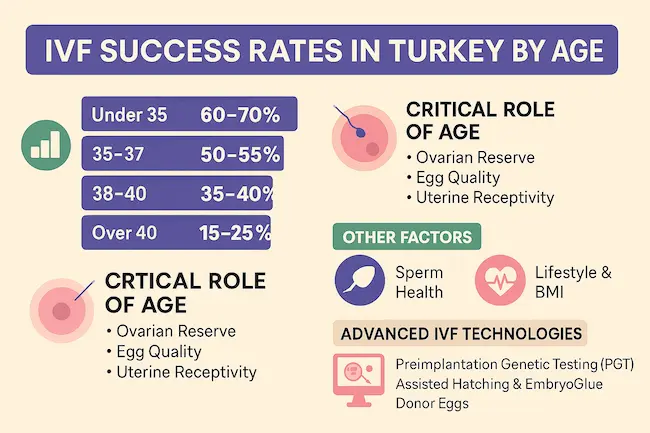
Women under 35 typically represent the most favorable group for IVF outcomes. In Turkey, IVF success rates under 35 range from 60% to 70% per cycle, with some elite centers achieving even higher results. This success is largely due to stronger ovarian reserves, better egg quality, and a healthier uterine environment.
Clinics in Istanbul have published data showing consistently high success rates for this demographic. For couples under 35, even the IVF first try success rate by age can be remarkably high, sometimes leading to pregnancy in the very first cycle.
Ages 35–37: Understanding the Gradual Decline
Between ages 35 and 37, fertility begins to decline more noticeably, though this age group still experiences solid outcomes. The IVF success rates in Turkey for this range typically fall between 50% and 55%. The reason for this decline lies in the gradual reduction in both egg quantity and quality. However, many Turkish fertility clinics mitigate these challenges with advanced stimulation protocols and individualized treatment plans.
Doctors often recommend embryo freezing at younger ages or using IVF with PGT success rates to identify chromosomally normal embryos, maximizing the chance of achieving a healthy pregnancy on the first or second cycle.
Ages 38–40: Navigating More Significant Challenges
For women aged 38 to 40, the chances of pregnancy begin to decrease more sharply due to an increased likelihood of chromosomal abnormalities and reduced ovarian response. In Turkey, the IVF success rates by age for this group are generally between 35% and 40% per cycle.
Still, many Turkish clinics excel at tailoring hormone protocols to optimize egg retrieval and fertilization outcomes. Some women in this group also consider IVF with PGT-A to enhance implantation chances and reduce miscarriage risks. Specialists may recommend blastocyst-stage transfers, which further improve implantation success.
Over 40: A Realistic View on Success Rates
Once a woman crosses the age of 40, the odds of success decrease substantially, mainly because of poor egg quality and a sharp decline in ovarian reserve. IVF success over 40 in Turkey typically ranges between 15% and 25%, depending on individual health factors.
At this stage, doctors often suggest using donor egg IVF to increase the likelihood of success. In fact, donor egg IVF success rates over 40 can climb as high as 65–75%, offering renewed hope to women who may not respond well to standard stimulation. Turkish fertility centers are known for their ethical donor programs, ensuring healthy, screened, and young egg donors to support women in this age bracket.
How to Interpret These Numbers: Live Birth Rate vs. Pregnancy Rate
It’s essential to understand that not all reported figures represent the same outcome. Many clinics list “pregnancy rates,” which include positive test results after embryo transfer, while others emphasize “live birth rates,” reflecting the number of babies born per cycle.
For a realistic perspective, always look for IVF success rates in Turkey based on live birth outcomes, as these figures give a clearer picture of treatment effectiveness. A pregnancy rate of 60% might translate to a 45–50% live birth rate after accounting for early miscarriages.
The Critical Role of Age: Why It’s the Biggest Factor in IVF Outcomes
When it comes to fertility, time truly matters. No matter how advanced the medical technology or how skilled the specialist, age remains the strongest predictor of IVF success. In Turkey, just as in other countries, younger women typically respond better to stimulation medications, produce higher-quality eggs, and achieve stronger embryo development. Understanding why this happens helps patients approach their fertility journey with realistic expectations and strategic planning.
Age affects nearly every biological process involved in reproduction—from hormone balance and egg health to the uterine environment. The following factors illustrate why age has such a profound impact on IVF success rates in Turkey.
Ovarian Reserve: The Link Between Egg Quantity and Age
A woman’s ovarian reserve refers to the number of eggs remaining in her ovaries. This number naturally declines over time, beginning to drop more rapidly after the age of 35. Fertility clinics in Turkey use diagnostic tools like AMH (Anti-Müllerian Hormone) testing and antral follicle count to assess ovarian reserve before treatment.
Younger women—particularly those under 35—tend to have a higher ovarian reserve, meaning they can produce more eggs during stimulation. This not only improves the odds of retrieving healthy eggs but also increases the likelihood of creating multiple viable embryos.
However, even for women with lower ovarian reserves, many Turkish clinics have developed individualized stimulation protocols. By carefully adjusting hormone doses, they can optimize egg yield and improve the IVF success rate under 35 and beyond.
Egg Quality and Chromosomal Abnormalities (Aneuploidy)
Beyond egg quantity, age also affects egg quality, which determines whether an embryo can develop into a healthy pregnancy. As women age, the likelihood of chromosomal abnormalities—known as aneuploidy—increases significantly. These abnormalities can lead to failed implantation, early miscarriage, or genetic conditions.
For women over 38, this is one of the main reasons for reduced IVF success rates by age. Turkish fertility centers often recommend IVF with PGT success rates as a strategic advantage here. Preimplantation Genetic Testing (PGT-A) screens embryos for chromosomal normality before transfer, ensuring only healthy embryos are selected. This approach not only increases success rates but also reduces the emotional toll of repeated failed cycles.
Many international patients traveling for IVF in Turkey appreciate that PGT testing and advanced embryology are available at a fraction of the cost compared to Europe or the US—making it easier to combine cutting-edge science with affordability.
How a Woman’s Age Affects Uterine Receptivity and Implantation
While most discussions about IVF focus on eggs, the uterus also plays a critical role in implantation and pregnancy maintenance. Interestingly, age has less impact on uterine receptivity than on egg quality. Studies and Turkish clinical data indicate that even women in their 40s can maintain a receptive uterine lining if hormonal balance is optimized.
This is one reason donor egg IVF success rates over 40 are often high—because a healthy uterus can still support pregnancy when high-quality donor embryos are transferred. Fertility specialists in Turkey closely monitor endometrial thickness and blood flow using ultrasound and Doppler imaging, ensuring the lining is ideal before transfer.
Additionally, advanced techniques like endometrial scratching, EmbryoGlue, and personalized hormonal support are used to improve implantation outcomes, especially for older patients.
Beyond Age: Other Key Factors Influencing Your IVF Success in Turkey
While age is undeniably the most powerful predictor of IVF outcomes, it is not the only factor determining whether treatment will result in a healthy pregnancy. Many couples undergoing IVF in Turkey experience different outcomes despite being the same age, mainly because several other biological and lifestyle elements come into play. Understanding these factors is key to maximizing your chances of success and choosing the right clinic for your unique needs.
The Importance of Sperm Health: It Takes Two
Fertility is a shared journey. In nearly 40% of infertility cases, male factors contribute either partly or entirely to the difficulty conceiving. Sperm quality—including count, motility, and morphology—directly influences fertilization and embryo development.
Turkish IVF clinics place a strong emphasis on sperm diagnostics. Advanced tests such as DNA fragmentation analysis help identify subtle issues that may not appear in routine semen analysis. Men with reduced sperm parameters may benefit from specialized procedures such as Intracytoplasmic Sperm Injection (ICSI), where a single sperm is directly injected into an egg, significantly improving IVF success rates in Turkey for couples with male infertility.
Moreover, treatments like antioxidant therapy, lifestyle modification, and varicocele repair are frequently offered in Turkey to enhance sperm quality before IVF, giving couples a better chance at producing healthy embryos.
Lifestyle and BMI: Factors You Can Control
Beyond biological elements, lifestyle choices play a crucial role in determining IVF success rates by age and overall health. Smoking, excessive alcohol consumption, chronic stress, and poor diet can negatively affect both egg and sperm quality. One of the most influential lifestyle factors, however, is Body Mass Index (BMI).
Being underweight or overweight can disrupt hormone balance, interfere with ovulation, and reduce uterine receptivity. Turkish fertility specialists often recommend achieving a BMI within the 19–25 range before starting treatment to maximize results. A healthy lifestyle also enhances response to ovarian stimulation and supports embryo implantation, directly improving outcomes for IVF in Turkey.
Many clinics provide pre-treatment wellness programs including nutrition counseling, stress management, and gentle exercise plans, helping patients regain hormonal balance and optimize fertility naturally before beginning medication.
Previous Pregnancy History and Cause of Infertility
A woman’s reproductive history can offer valuable clues about potential outcomes. Patients who have had previous successful pregnancies (either naturally or through IVF) often have higher chances of success in future cycles. However, a history of repeated miscarriages, uterine abnormalities, or severe endometriosis can reduce the IVF success rate under 35 or any other age group.
Turkish fertility centers perform detailed diagnostic evaluations to uncover the root causes of infertility. Tests for tubal blockage, immune dysfunction, hormonal imbalance, and uterine anomalies help tailor the most effective treatment plan. Correcting underlying conditions—such as polyps or thyroid dysfunction—before IVF can significantly raise success rates.
The Expertise of the Clinic and Embryology Lab in Turkey
Perhaps one of the most overlooked yet crucial factors influencing IVF success rates in Turkey is the clinic itself. A well-equipped laboratory, experienced embryologists, and personalized care protocols make a measurable difference.
Turkey is home to several internationally recognized IVF centers that adhere to European Society of Human Reproduction and Embryology (ESHRE) standards. These clinics invest heavily in advanced incubator technology, micromanipulation systems, and time-lapse monitoring, allowing embryologists to observe development in real time and select the most viable embryos for transfer.
Equally important is the clinical expertise of fertility specialists. Doctors in leading Turkish IVF clinics often have international training in reproductive endocrinology and decades of experience handling complex cases. This combination of cutting-edge technology and human skill ensures the highest level of precision and care—making IVF success rates in Turkey consistently strong compared to global averages.
Maximizing Your Chances: The Turkish Advantage in Advanced IVF Technologies
One of the reasons Turkey stands out as a global leader in fertility treatment is its seamless combination of world-class medical technology, expert reproductive specialists, and cost-efficient pricing. Modern Turkish IVF clinics do not simply replicate Western methods—they innovate by integrating advanced laboratory tools, personalized patient care, and evidence-based techniques that directly enhance IVF success rates in Turkey.
For international couples, this means greater access to cutting-edge science without the financial strain typically associated with top-tier fertility programs abroad.
Preimplantation Genetic Testing (PGT-A) for Embryo Selection
Among the most influential innovations boosting IVF success rates by age is Preimplantation Genetic Testing for Aneuploidy (PGT-A). This technique analyzes the chromosomes of embryos before transfer, ensuring that only those with normal genetic profiles are chosen. The result is a significant rise in implantation rates and a drop in miscarriage risk.
Turkish fertility centers are among the first in the region to integrate next-generation sequencing (NGS) into their IVF workflows. This allows embryologists to detect chromosomal abnormalities with high precision, giving doctors the data needed to choose the healthiest embryo for transfer.
For older women—especially those over 38—PGT-A dramatically improves results. Clinics report that IVF with PGT success rates can reach 60% or more in carefully selected patients, making it a game-changing option for women who have experienced multiple failed cycles or miscarriages.
Improving Outcomes with Assisted Hatching and EmbryoGlue
Another innovation widely practiced in Turkey is assisted hatching, a laboratory procedure that gently thins or opens the outer layer (zona pellucida) of the embryo to help it implant more easily. This is particularly beneficial for women of advanced age or those with previous implantation failures.
Complementing this is the use of EmbryoGlue, a special transfer medium enriched with hyaluronan that mimics the natural environment of the uterus. Together, these techniques enhance the attachment of embryos to the uterine lining, improving both pregnancy and live birth outcomes.
Many Turkish clinics integrate these procedures as part of standard treatment—rather than charging extra—ensuring that couples benefit from the latest reproductive technologies regardless of budget. These small laboratory refinements can collectively raise IVF success rates in Turkey across all age brackets.
The Role of Donor Eggs in Turkey for Women of Advanced Maternal Age
For women over 40, egg quality often becomes the biggest challenge to overcome. In such cases, donor egg IVF offers a viable and often highly successful solution. Using eggs from younger, healthy donors dramatically increases the chance of pregnancy.
Many patients in their forties who had multiple failed IVF attempts with their own eggs finally succeed after switching to a donor-egg program in Turkey. Combined with advanced embryo selection and supportive care, this option provides new hope for women seeking motherhood later in life.
Cost-Effectiveness: How Turkish Prices Allow for More Attempts
The affordability of treatment is another major reason Turkey has become a top choice for fertility tourism. Compared to Europe or North America, the cost of IVF in Turkey can be 50–70% lower, without compromising on quality.
This cost advantage allows couples to undergo multiple IVF cycles if necessary—a key factor in achieving pregnancy, as success often increases with repeated attempts. Since IVF success rates by age decline naturally over time, the ability to afford more than one cycle can make a critical difference.
Furthermore, packages in Turkey often include medications, PGT testing, or donor programs at rates far below those found in Western countries. This makes it possible for couples to combine high success rates, advanced medical technology, and affordability all in one place.