Choosing the best rhinoplasty surgeon in Turkey is not just about finding someone with impressive before-and-after photos—it’s about identifying a specialist who combines artistic precision, medical expertise, and patient-centered care. Turkey has become the global destination for rhinoplasty and nose job in Turkey, drawing thousands of international patients to Istanbul each year. In this section, we explore why the country has earned this reputation and what makes Turkish surgeons some of the most sought-after in the world.
Table of Contents
Why is Turkey a Global Hub for Rhinoplasty?
Over the past decade, Turkey—particularly Istanbul—has positioned itself as a leader in the field of rhinoplasty in Turkey, thanks to its blend of high medical standards and competitive prices. Patients from Europe, the UK, and the Middle East often travel for a nose job in Turkey because of its exceptional combination of affordability, advanced techniques, and world-class facilities. This global reputation is supported by government-backed investments in medical tourism and a strong culture of innovation within aesthetic medicine.
Turkish surgeons often perform hundreds of rhinoplasty procedures annually, giving them unparalleled experience compared to many counterparts abroad. This high patient volume allows for refined surgical skills and exposure to diverse nasal structures, making them adept at achieving natural, customized results that enhance rather than alter a patient’s facial harmony.
The “Triangle of Value”: Elite Surgeon Expertise, Advanced Technology, and Affordability
When searching for the best rhinoplasty surgeon in Turkey, one must consider the “Triangle of Value”—three essential pillars that define Turkey’s dominance in aesthetic surgery: surgeon expertise, modern medical technology, and cost efficiency.
- Elite Surgeon Expertise: Many of the best rhinoplasty surgeons in Istanbul are trained both domestically and internationally, often holding certifications from European or American boards. Their dual training gives them a global perspective and understanding of diverse facial aesthetics.
- Advanced Technology: Modern Turkish clinics are equipped with cutting-edge imaging tools like 3D simulation software (such as Vectra) and ultrasonic instruments that enable more precise bone contouring and faster recovery.
- Affordability: Despite world-class quality, the rhinoplasty in Turkey cost is often 50–70% lower than in Western countries. This affordability does not stem from lower standards but rather favorable economic conditions and government-supported healthcare tourism initiatives.
These three components together create a rare balance that makes Turkey the top choice for patients seeking the best nose job surgeon in Turkey.
Understanding the Specialists: ENT Surgeon vs. Facial Plastic Surgeon
In Turkey, rhinoplasty can be performed by two main types of specialists: ENT (Ear, Nose, and Throat) surgeons and facial plastic surgeons. Understanding the difference is vital when selecting the right doctor for your procedure.
- ENT Surgeons specialize in nasal structure and function. They are ideal if you require both cosmetic improvement and correction of breathing issues such as septum deviation.
- Facial Plastic Surgeons have a broader focus on facial aesthetics and harmony. They are excellent choices for purely cosmetic nose reshaping or refinement procedures.
The best rhinoplasty surgeon in Turkey often holds dual expertise—meaning they are trained in both ENT and facial plastic surgery. This dual qualification ensures a comprehensive approach that prioritizes both aesthetic outcome and respiratory function.
The Importance of International Accreditations (JCI, ISAPS)
A crucial factor distinguishing the best rhinoplasty surgeon in Istanbul is the hospital or clinic’s accreditation. Look for institutions certified by JCI (Joint Commission International) or surgeons affiliated with professional organizations such as ISAPS (International Society of Aesthetic Plastic Surgery).
These accreditations confirm that the facility adheres to strict global safety and quality standards, covering everything from surgical protocols to post-operative care. Patients who choose JCI-accredited hospitals benefit from advanced hygiene standards, multidisciplinary medical support, and reliable post-surgical follow-up—ensuring a safe and consistent experience throughout their medical journey in Turkey.
When comparing surgeons, always verify these credentials; they are a clear indicator of professionalism and adherence to international best practices.
Decoding Surgeon Credentials: What Separates “Good” from “Best”
Once you’ve narrowed down your options, the next step is to understand what truly defines the best rhinoplasty surgeon in Turkey. Many surgeons claim expertise in rhinoplasty, but only a select few possess the credentials, surgical focus, and proven results that distinguish them from the rest. In this section, we’ll explore how to assess qualifications, verify certifications, and identify surgeons who specialize in achieving both functional and aesthetic perfection.
How to Verify Turkish Board Certification and International Memberships
Before choosing a surgeon, always verify their credentials through official channels. The best rhinoplasty surgeons in Turkey are certified by the Turkish Society of Plastic, Reconstructive, and Aesthetic Surgery (TPCD) or the Turkish Society of Otorhinolaryngology-Head and Neck Surgery. These organizations require surgeons to undergo rigorous training, examinations, and continuous professional development.
However, national certification alone is not enough. The most respected surgeons also hold memberships in international bodies such as:
- ISAPS (International Society of Aesthetic Plastic Surgery)
- EBOPRAS (European Board of Plastic, Reconstructive, and Aesthetic Surgery)
- American Society of Plastic Surgeons (ASPS)
These memberships reflect a commitment to maintaining international surgical standards and staying updated with the latest advancements in techniques and patient safety. Patients looking for the best rhinoplasty surgeon in Istanbul should always cross-check the surgeon’s name on these organizations’ official websites to confirm authenticity.
A common pitfall patients face is trusting unofficial “certificates of participation” rather than recognized board certifications. These do not represent surgical mastery or peer-reviewed qualifications. Always ask your clinic for verifiable evidence of board status and hospital privileges.
Experience vs. Specialization: Why a Rhinoplasty-Focused Surgeon is Crucial
Rhinoplasty is widely considered one of the most technically demanding procedures in cosmetic surgery. Even minor errors in cartilage shaping or nasal tip alignment can drastically affect appearance and breathing. This is why experience matters—but specialization matters even more.
The best rhinoplasty surgeons in Turkey typically dedicate the majority of their practice to nasal surgery alone. These surgeons perform hundreds of nose jobs in Turkey annually, continuously refining their skills in both open and closed rhinoplasty techniques. This intense focus allows them to master nuances of nasal anatomy, handle complex cases, and achieve long-term natural outcomes.
In contrast, general plastic surgeons who divide their time between different aesthetic procedures (such as breast augmentations or facelifts) may not have the same precision or artistic understanding specific to nasal aesthetics.
When consulting a surgeon, ask them directly about the percentage of their surgical practice devoted specifically to rhinoplasty. A true expert will confidently say that rhinoplasty forms the core of their work.
Analyzing Their Expertise in Primary vs. Revision Rhinoplasty
There’s a significant difference between performing a primary rhinoplasty and a revision rhinoplasty. While primary cases involve reshaping the nose for the first time, revision procedures require reconstructing tissue and cartilage after a previous surgery—often one done incorrectly elsewhere.
The best rhinoplasty surgeon in Turkey should have demonstrated skill in both areas. Revision cases are particularly complex, requiring advanced grafting techniques and an in-depth understanding of nasal reconstruction. Patients considering revision rhinoplasty in Istanbul should specifically seek surgeons who showcase before-and-after portfolios dedicated to such cases.
A skilled revision expert focuses on restoring both aesthetics and nasal function, ensuring breathing issues from prior operations are corrected. The surgeon’s ability to manage scar tissue, rebuild symmetry, and achieve natural balance is what separates an experienced specialist from a general cosmetic practitioner.
Before making a decision, ask to see a mix of both primary and revision results from real patients. A surgeon who performs revision rhinoplasty confidently demonstrates a higher level of expertise and problem-solving ability.
Beyond the “Perfect” Portfolio: How to Critically Analyze Results
When searching for the best rhinoplasty surgeon in Turkey, it’s easy to be impressed by flawless before-and-after galleries. However, what you see online doesn’t always reflect the surgeon’s true skill or consistency. Modern editing tools and selective presentation can make results appear more perfect than they are. That’s why it’s essential to learn how to evaluate real patient outcomes, detect misleading visuals, and verify authentic reviews before making a decision.

A Guide to Vetting Before-and-After Galleries (Look for Consistency)
A strong before-and-after portfolio is a window into a surgeon’s artistry and precision. When reviewing galleries from a rhinoplasty clinic in Istanbul, consistency is key. The best nose job surgeons in Turkey display a large number of results featuring different facial types, ethnic backgrounds, and nasal structures.
Here’s what to look for:
- Angle Consistency: Photos should be taken from identical angles (front, side, and base views) with the same lighting and background. Inconsistent angles may hide imperfections.
- Diverse Cases: A qualified surgeon’s gallery includes both male and female patients, as well as a variety of nasal shapes—wide, droopy, bulbous, or asymmetrical. This variety reflects adaptability and mastery across complex anatomy.
- Natural Outcomes: The hallmark of the best rhinoplasty surgeon in Turkey is subtlety. The results should enhance facial harmony without looking overdone or “plastic.”
If every patient in a gallery has an almost identical nose, be cautious. A skilled surgeon customizes each procedure to fit the individual’s face rather than applying a “template” aesthetic.
How to Spot Over-Edited or Misleading Patient Photos
In today’s digital world, image manipulation has become common. Some clinics use filters, retouching, or altered lighting to exaggerate results. The best rhinoplasty surgeons in Istanbul do not rely on such tactics—they let their genuine surgical outcomes speak for themselves.
Here are a few red flags to watch for:
- Skin Texture Differences: If post-operative photos look unusually smooth or blurred, it might indicate editing.
- Lighting Tricks: Softer lighting in “after” images can make the nose appear slimmer or smoother than it truly is.
- Makeup and Shadows: Some clinics use contouring makeup to simulate a refined nasal bridge. Authentic surgical galleries prohibit makeup during photo sessions.
To confirm authenticity, check if the surgeon shares unretouched videos or patient testimonials. Many top Turkish surgeons now post real-time recovery clips and live consultations on Instagram or YouTube, offering transparent proof of their work.
Finding Authentic Patient Reviews on Google, RealSelf, and Trustpilot
Patient reviews are another powerful way to measure a surgeon’s reputation. Look for verified feedback on Google, RealSelf, and Trustpilot rather than testimonials on a clinic’s own website, which are often filtered or selectively published.
Pay attention to:
- Details of the Experience: Reliable reviews describe communication, recovery process, and post-operative support.
- Long-Term Satisfaction: The most valuable feedback comes from patients who write months after their surgery, once swelling has settled and results are stable.
- Clinic Response: A reputable rhinoplasty clinic in Turkey responds professionally to all reviews—positive or negative—showing accountability and care.
Also, note that the best rhinoplasty surgeons in Turkey often have multilingual reviews, reflecting their international patient base. Reviews in English, Arabic, Russian, and German indicate the clinic’s global trust and cross-border patient satisfaction.
Before committing, you can also request to speak with a previous international patient. Leading clinics are usually open to sharing contact with consent, allowing you to ask about the full experience directly.
Your Consultation Checklist: The 5 Key Questions You Must Ask
Booking a consultation with a rhinoplasty surgeon in Turkey is the defining step in your decision-making journey. Whether online or in person, this meeting determines not only if the doctor understands your aesthetic goals but also how transparent, experienced, and communicative they are. The best rhinoplasty surgeon in Turkey will never rush you; instead, they will carefully explain every detail—from surgical approach to recovery timeline. Asking the right questions during this stage ensures you choose a surgeon who values safety, artistry, and long-term satisfaction over quick results.
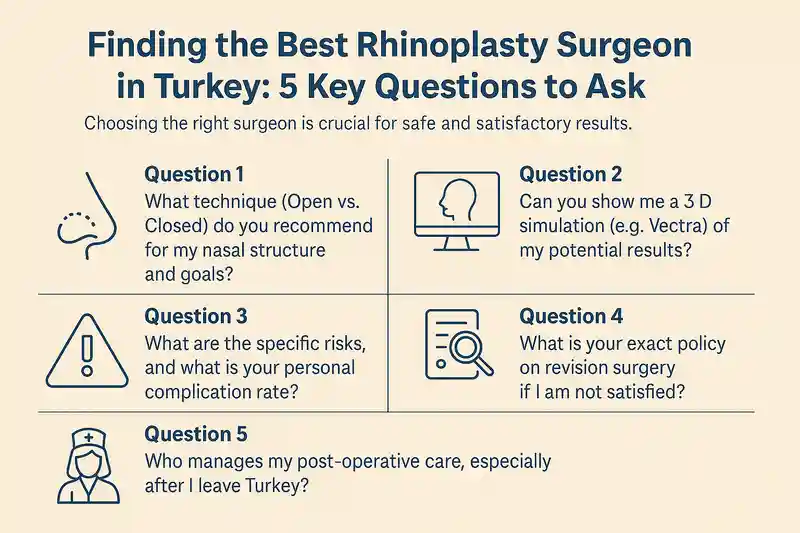
Question 1: “What technique (Open vs. Closed) do you recommend for my nasal structure and goals?”
Understanding the difference between open and closed rhinoplasty is vital.
- In open rhinoplasty, the surgeon makes a small incision between the nostrils, allowing full visibility of the nasal framework. It’s ideal for complex reshaping, revisions, or asymmetrical noses.
- Closed rhinoplasty, on the other hand, involves incisions made inside the nostrils, leaving no external scars and resulting in a faster recovery.
The best rhinoplasty surgeon in Istanbul will recommend the technique based on your facial proportions, nasal cartilage condition, and desired result—not on convenience. A personalized explanation of why one method suits you better is a sign of genuine expertise and ethical practice.
Question 2: “Can you show me a 3D simulation (e.g., Vectra) of my potential results?”
Leading clinics in Turkey often use advanced 3D imaging systems such as Vectra to visualize potential outcomes. This simulation helps align your expectations with realistic surgical possibilities.
The best nose job surgeon in Turkey uses this tool not to promise perfection but to show you a probable result based on your anatomy. It’s also an opportunity for open discussion—you can express preferences regarding tip projection, bridge height, or symmetry adjustments.
If a clinic refuses to provide preoperative imaging or offers vague visual explanations, it’s best to reconsider. Transparent surgeons rely on technology to enhance communication and ensure mutual understanding before surgery.
Question 3: “What are the specific risks, and what is your personal complication rate?”
Every surgical procedure carries risk, and honest communication about those risks reflects professionalism. The best rhinoplasty surgeons in Turkey maintain low complication rates thanks to meticulous surgical technique and experience.
During your consultation, ask for statistical transparency. A qualified surgeon can confidently discuss their average complication or revision rate and describe how they manage unexpected outcomes like bleeding, infection, or asymmetry. Avoid clinics that claim “zero risk” or “guaranteed perfection”—these promises are unrealistic and unethical in medical practice.
Question 4: “What is your exact policy on revision surgery if I am not satisfied?”
Even with the best rhinoplasty surgeon in Turkey, minor refinements may occasionally be necessary due to individual healing patterns or tissue responses. A professional, patient-centered clinic will offer a revision policy that is fair, transparent, and focused on patient satisfaction.
Ask the surgeon:
- Is there a waiting period before revision can be performed (usually 6–12 months)?
- Are revisions covered within the initial fee, or is there an additional charge?
- How often do they personally perform revisions, and what are their results?
The answer will show how confident the surgeon is in their outcomes. The best rhinoplasty surgeons in Istanbul maintain less than a 5–10% revision rate and handle most touch-ups themselves rather than delegating to junior staff.
Question 5: “Who manages my post-operative care, especially after I leave Turkey?”
Aftercare is often overlooked, but it is one of the most critical aspects of a successful nose job in Turkey. Swelling, bruising, and subtle shape changes can continue for months after surgery. The best rhinoplasty surgeons in Turkey provide structured post-operative follow-up, including video check-ins, healing guidance, and direct communication channels with medical coordinators.
Ask whether:
- You will receive a written post-op plan before leaving.
- The clinic provides 24/7 English-speaking support.
- They offer remote follow-up consultations after returning home.
High-quality clinics will have multilingual staff and clear communication systems to ensure international patients receive continuous care.
Your Surgical Journey: The Clinic, the Team, and Aftercare
Choosing the best rhinoplasty surgeon in Turkey means more than selecting a skilled professional—it’s about trusting the entire ecosystem that supports your surgery. From the clinic’s accreditation and surgical team to your recovery and long-term care, every step matters in achieving a safe and satisfying outcome. Turkey’s world-class facilities are designed to provide comfort, transparency, and medical excellence for international patients seeking the perfect nose job in Turkey.
Evaluating the Hospital vs. the Clinic: JCI Accreditation and Safety Standards
The quality of the facility where your rhinoplasty is performed is just as critical as the surgeon’s skill. The best rhinoplasty surgeons in Istanbul operate in hospitals or clinics accredited by JCI (Joint Commission International) or recognized by Turkey’s Ministry of Health. These accreditations guarantee compliance with strict international standards on hygiene, patient safety, and surgical protocols.
When evaluating a clinic, check the following:
- Operating Room Sterility: JCI-accredited centers maintain sterile operating environments with advanced filtration and sterilization systems.
- Emergency Readiness: The presence of intensive care units and emergency teams in the same building adds an important safety layer, especially for patients traveling from abroad.
- Transparency: Leading hospitals encourage patient tours or virtual walkthroughs before surgery, proving there’s nothing to hide.
Facilities with advanced equipment—like ultrasonic piezo rhinoplasty tools or digital imaging systems—demonstrate their commitment to precision and innovation. A well-equipped, certified hospital ensures both aesthetic excellence and medical safety, setting the standard for the best rhinoplasty in Turkey experience.
The Support Team: Assessing the Anesthesiologist and English-Speaking Staff
A successful rhinoplasty relies on teamwork. The best rhinoplasty surgeons in Turkey work alongside highly qualified anesthesiologists, nurses, and coordinators who ensure smooth operation and patient comfort.
- Anesthesiologist Expertise: A skilled anesthesiologist monitors vital functions and adjusts medication for each individual’s safety and comfort. Their presence during every procedure—not just occasionally—is a hallmark of top-tier clinics.
- Nursing and Support Staff: Multilingual nurses and coordinators assist international patients from the moment they arrive at the airport. They guide you through every step—consultation, surgery, and recovery—while ensuring clear communication and compassionate care.
- Patient Coordinator: Dedicated English-speaking coordinators act as your point of contact before and after surgery, bridging any language or cultural gaps.
In Turkey’s leading clinics, this professional support team is one of the reasons patients describe their experience as stress-free and personalized. Their attention to detail ensures that every question is answered, and every concern is addressed promptly.
The First 10 Days: A Realistic Post-Operative Recovery Timeline
Recovery after rhinoplasty is a crucial phase that determines the success of your results. Understanding what happens day by day helps set realistic expectations and reduces anxiety.
- Day 1–2: Mild swelling and nasal pressure are normal. You’ll be monitored closely by your medical team.
- Day 3–5: Bruising around the eyes may appear but typically peaks around day three before fading. Breathing improves as nasal packing is removed.
- Day 6–7: Stitches or splints are removed, and the new nasal contour becomes visible for the first time.
- Day 8–10: Most patients feel comfortable traveling or returning to light activities. However, full recovery and final refinement continue for several months.
The best rhinoplasty surgeons in Istanbul provide comprehensive aftercare instructions, including medication, cleaning techniques, sleeping position advice, and follow-up video calls. Reputable clinics also supply post-surgery care kits with saline sprays, ice packs, and gentle skincare recommendations to aid recovery.
Best Rhinoplasty Surgeon in Turkey Frequently Asked Questions:
How do I choose the best rhinoplasty surgeon in Turkey?
Start by shortlisting surgeons who focus mainly on rhinoplasty, check their board certifications, review large before-and-after galleries, and read independent patient reviews. Then book a consultation to see whether they listen to your goals and explain the plan clearly.
What makes Turkey a global hub for the best rhinoplasty surgeons?
Turkey, especially Istanbul, combines very high surgical volumes, advanced technology (like 3D simulation and ultrasonic tools), and competitive prices. This mix attracts thousands of international patients every year for nose job surgery.
Which credentials should the best rhinoplasty surgeon in Istanbul have?
Look for Turkish board certification in Plastic, Reconstructive and Aesthetic Surgery or ENT, plus memberships in international societies such as ISAPS or EBOPRAS. Verified hospital privileges in accredited (JCI) clinics are another key quality marker.
Why is it important to choose a rhinoplasty-focused specialist in Turkey?
Rhinoplasty is one of the most complex cosmetic surgeries, so results are better with surgeons who perform nose jobs every day. A rhinoplasty-focused specialist has deeper experience with nasal anatomy, revision cases, and balancing function with aesthetics.
How can I check if a “best rhinoplasty surgeon in Turkey” really delivers natural results?
Study their before-and-after photos for consistent angles, neutral lighting, and a variety of nose types and faces. Results should look natural and individualized rather than like the same “template” nose on every patient.
What questions should I ask during my consultation with a rhinoplasty surgeon in Turkey?
Ask which technique (open or closed) they recommend for you, how many rhinoplasties they perform per year, their complication and revision rates, and what their revision policy and aftercare plan include. Clear, transparent answers show you are dealing with a true expert.