
Discover everything you need to know about rhinoplasty (Nose Job) in Turkey—from world-class surgeons and modern techniques to recovery, costs, and all-inclusive medical tourism packages designed for international patients seeking natural, lasting results.
Table of Contents
Why Choose Turkey for Your Rhinoplasty?
Turkey has become a global hub for cosmetic nose surgery thanks to experienced surgeons, advanced technology, and hospital standards that welcome international patients. Before comparing costs or techniques, it helps to understand why so many travelers select Rhinoplasty in Istanbul and other major cities.
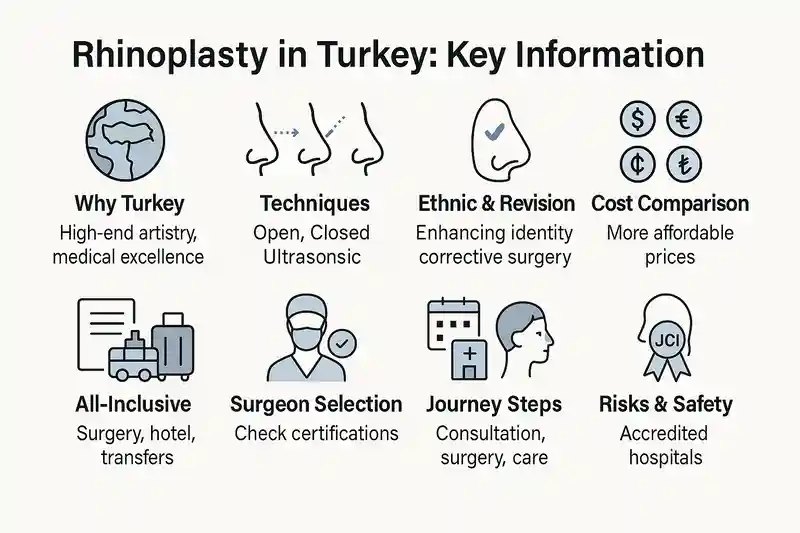
The Turkish Advantage: Combining High-End Artistry with Medical Excellence
Top Turkish surgeons perform a high volume of nose surgeries each year, refining both functional and aesthetic outcomes. Global procedure data show rhinoplasty remains one of the most popular cosmetic surgeries worldwide, with about one million procedures reported in the latest ISAPS survey, underscoring growing expertise and patient demand internationally.
In addition to surgical experience, large private hospital groups in Istanbul and other cities invest in modern operating theaters and imaging, 3D simulation, and techniques like Ultrasonic Rhinoplasty in Turkey for precise bone work while protecting soft tissue. These tools help surgeons craft natural-looking profiles that fit facial harmony.
By the Numbers: 2025 Rhinoplasty Success Rates & Medical Tourism Statistics
Public, standardized “success rates” are not reported at a national level, so any single percentage online should be treated cautiously. What can be measured is scale and accreditation. Istanbul’s health sector highlights dozens of internationally accredited facilities, and ISAPS’ most recent reports confirm rhinoplasty’s strong global volume, reflecting mature protocols and surgeon experience worldwide. For context, Istanbul alone hosts a significant share of the world’s JCI-accredited organizations operating in one city, signaling a quality focus that benefits visiting patients.
Independent roundups and industry overviews also describe Turkey’s sizeable medical-tourism flow for cosmetic procedures, including Nose Job in Turkey, though absolute traveler counts vary by source and year. Use such figures as directional rather than definitive, and verify clinic-level outcomes during consultation.
JCI-Accredited Hospitals: Why International Safety Standards Matter
JCI accreditation audits patient safety systems, surgical processes, infection control, anesthesia care, and continuous improvement. Choosing a JCI-accredited hospital helps ensure consistent protocols during your Rhinoplasty in Turkey, from pre-op assessment through post-op monitoring. You can confirm a hospital’s status directly on JCI’s public directory, and Istanbul’s investment office notes that dozens of JCI-accredited providers operate in the city. This combination of international oversight and local experience is a major reason patients trust Rhinoplasty in Istanbul.
Rhinoplasty (Nose Job) in Turkey Cost
Price is a key reason travelers compare Rhinoplasty in Turkey Cost with the UK, USA, and Europe. Rates vary by surgeon seniority, hospital tier, case complexity, and technique. Always review what is included, not just the headline number.
Average Nose Job Cost: Turkey vs. UK, USA, and Europe
Recent clinic and market guides commonly quote All-Inclusive Rhinoplasty in Turkey packages starting around €2500 to €5500, while typical quotes in the UK and USA are significantly higher. Representative comparisons show Turkey often undercuts UK and USA averages by a wide margin, but ranges differ across providers and cities. Treat any figure as an estimate until you receive a personalized plan after consultation and imaging.
What’s Included in an “All-Inclusive” Rhinoplasty Package?
Packages for Rhinoplasty in Turkey usually bundle airport transfers, hotel stays, hospital and anesthesia fees, surgeon fees, medications for the first days, and translation or patient-host support. Some clinics also include imaging, post-op checkups, and protective taping supplies. Always ask for a written itemization and clarify exclusions such as extra nights, companion costs, or unexpected revisions.
Price Factors: How Technique and Surgeon Skill Affect Cost
Technique and complexity change the quote. Open Rhinoplasty in Turkey tends to be priced differently from Closed Rhinoplasty in Turkey because exposure and operative time vary. Ultrasonic Rhinoplasty in Turkey can add cost due to specialized equipment and meticulous bone sculpting benefits. Revision cases are more complex, often requiring cartilage grafts and longer anesthesia, which raises fees. These variables explain why quotes differ even within the same city.
Are You an Ideal Candidate for a Nose Job?
A successful rhinoplasty in Turkey begins with the right patient selection. Surgeons carefully evaluate both physical and emotional readiness before recommending surgery. This ensures that every nose job in Turkey leads to safe, satisfying, and lasting results.

Physical & Medical Requirements
Patients seeking rhinoplasty in Istanbul should be in good general health, free from uncontrolled chronic conditions, and at least 18 years old (to ensure nasal growth has completed). A detailed medical history, blood tests, and imaging are performed before surgery. Your surgeon will assess nasal structure, skin thickness, and breathing function to design a customized plan.
Ideal candidates usually aim to correct one or more issues such as nasal humps, wide bridges, bulbous tips, crooked shapes, or breathing difficulties caused by septal deviation. If both aesthetic and functional concerns exist, your surgeon might combine functional septoplasty with aesthetic reshaping for optimal results.
Psychological Readiness: Managing Expectations for a “Perfect” Nose
Emotional preparedness is as important as physical health. While rhinoplasty in Turkey can dramatically enhance appearance, expecting perfection or wanting to look like a celebrity often leads to disappointment. Surgeons emphasize realistic outcomes—improving balance and harmony, not copying someone else’s features.
During consultations, clinics often use 3D simulation software to visualize post-operative results. This helps patients set achievable goals and understand natural variations due to bone and cartilage anatomy. Reputable surgeons will always prioritize facial harmony and breathing functionality over exaggerated aesthetic changes.
Who Is Not a Good Candidate?
Not everyone qualifies for rhinoplasty in Turkey. Patients with untreated sinus infections, blood clotting disorders, or uncontrolled diabetes may face surgical risks. Smokers are advised to quit weeks before and after surgery to ensure proper healing and minimize complications.
People seeking surgery to please others—rather than for personal confidence—may not benefit emotionally. Additionally, those who have undergone multiple nasal surgeries may require revision rhinoplasty in Turkey, where expectations and results must be discussed cautiously. The best rhinoplasty surgeons in Turkey are transparent about these limitations and may recommend alternative solutions if surgery is not ideal.
Open vs. Closed Rhinoplasty: Which Technique is Best for You?
Choosing between open and closed rhinoplasty in Turkey depends on your anatomy, correction goals, and your surgeon’s approach. Both techniques have distinct advantages, and the final choice should be tailored to your individual case.
Open Rhinoplasty: The Pros and Cons
In open rhinoplasty, the surgeon makes a small incision across the columella (the strip of tissue between the nostrils) to lift the nasal skin and fully expose the bone and cartilage. This allows for greater precision in complex reshaping, grafting, or correcting previous surgical errors.
Open rhinoplasty is especially recommended for revision rhinoplasty in Turkey, asymmetry corrections, or tip reshaping that requires maximum visibility. The potential downside is a slightly longer recovery period and minor swelling around the nasal tip, but the external scar is almost invisible after healing.
Closed Rhinoplasty: The Pros and Cons
Closed rhinoplasty in Turkey involves incisions inside the nostrils, leaving no external scars. It offers faster healing, less swelling, and shorter operation time. This technique works best for patients needing moderate reshaping, such as smoothing a nasal hump or refining the bridge.
However, since visibility is limited, closed rhinoplasty may not be suitable for patients requiring complex cartilage work or multiple corrections. Still, it remains a preferred method among international patients seeking minimal downtime and natural results.
Ultrasonic (Piezo) Rhinoplasty: The High-Tech Advantage for Precise Bone Shaping
One of the most innovative techniques available today is ultrasonic rhinoplasty in Turkey, also known as Piezo rhinoplasty. Instead of traditional chisels, surgeons use ultrasound waves to sculpt nasal bones with millimeter accuracy.
This modern approach reduces tissue trauma, bleeding, and bruising, leading to faster recovery and more refined results. It’s ideal for patients who want structural changes with minimal swelling or asymmetry risks. Many clinics in Istanbul highlight ultrasonic technology as a key part of their premium rhinoplasty packages—demonstrating Turkey’s commitment to advanced, patient-friendly cosmetic surgery.
Ethnic Rhinoplasty in Turkey: Enhancing, Not Erasing, Your Identity
Modern rhinoplasty in Turkey has evolved far beyond one-size-fits-all beauty standards. Today, Turkish surgeons are internationally recognized for performing ethnic rhinoplasty in Turkey—a highly specialized approach that refines nasal structure while preserving each patient’s cultural and facial identity. This balance between enhancement and authenticity is one of the reasons why Turkey remains a top destination for international cosmetic travelers.
What is Ethnic Rhinoplasty?
Ethnic rhinoplasty is designed for patients of African, Asian, Middle Eastern, Mediterranean, or Latin descent who wish to improve nasal proportions without losing their unique features. The goal is not to create a European-style nose but to harmonize the nose with the rest of the face.
Common requests include narrowing wide nostrils, refining bulbous tips, or enhancing bridge projection while maintaining natural ethnic characteristics. Turkish surgeons combine aesthetic artistry with a deep understanding of cultural anatomy to produce results that feel balanced and authentic.
During consultations, clinics often use 3D morphing tools to preview expected outcomes. This ensures both surgeon and patient share the same vision—whether that means subtle refinement or more defined structural change.
Specialized Techniques for African, Asian, and Middle Eastern Noses
Different ethnic groups present different anatomical characteristics. For example, African noses often feature softer cartilage and wider nostrils, while Asian noses may have flatter bridges and thicker skin. Middle Eastern noses, on the other hand, often involve dorsal humps or drooping tips that require controlled bone reshaping.
Experienced Turkish surgeons adjust their techniques accordingly. They may use cartilage grafts, structural tip support, or ultrasonic rhinoplasty in Turkey for precise bone contouring without damaging surrounding tissues. This personalized approach ensures long-term stability, symmetry, and natural beauty.
Ethnic rhinoplasty is also highly popular among international patients visiting Istanbul, as the city’s clinics offer bilingual medical consultants and travel coordinators. Many patients travel from the UK, UAE, USA, and Europe, confident that their cultural features will be respected throughout the surgical process.
The Importance of Cartilage Grafts in Ethnic Reshaping
Cartilage grafts—often harvested from the septum, ear, or rib—play a crucial role in ethnic rhinoplasty. Since some ethnic noses have thinner internal support or require bridge augmentation, grafts are used to improve projection, refine the tip, and maintain long-term structural integrity.
In rhinoplasty in Turkey, surgeons prefer using the patient’s own cartilage to reduce rejection risks and achieve smooth, natural contours. This technique not only enhances shape but also reinforces breathing functionality—especially in patients who previously had breathing issues or underwent unsuccessful cosmetic procedures abroad.
Turkish clinics frequently combine ultrasonic and open rhinoplasty techniques for ethnic cases to achieve precision and symmetry. The results are often long-lasting, with balanced facial harmony and improved confidence.
Revision Rhinoplasty in Turkey: Correcting a Previous Surgery
For many patients, a second or third nose job in Turkey offers the chance to correct complications or unsatisfactory results from earlier procedures performed elsewhere. Known as revision rhinoplasty in Turkey, this procedure requires exceptional surgical expertise and a customized approach.
Why is Revision Rhinoplasty More Complex?
Revision rhinoplasty is one of the most challenging operations in aesthetic surgery. The nasal anatomy has already been altered, internal scar tissue may have formed, and cartilage or bone support could be weakened.
Top surgeons in Istanbul carefully plan each revision using CT imaging, 3D modeling, and sometimes ultrasonic tools for precise bone sculpting. The main goals are restoring symmetry, improving breathing function, and achieving natural beauty without further trauma.
In many cases, revision procedures also involve grafting from the ear or rib to rebuild nasal structure. Due to the complexity, the operation may last longer and require a slightly extended recovery period compared to a primary rhinoplasty.
Finding a Specialist: What to Look for in a Revision Surgeon
When choosing a revision rhinoplasty in Turkey, focus on surgeon experience and certification. Look for specialists accredited by EBOPRAS (European Board of Plastic, Reconstructive and Aesthetic Surgery) or members of ISAPS (International Society of Aesthetic Plastic Surgery).
A qualified best rhinoplasty surgeon in Turkey should have a portfolio of before-and-after images showcasing complex revision cases. During consultation, ensure they discuss potential challenges openly and provide realistic expectations.
It’s also wise to ask about the clinic’s revision policy—some reputable hospitals include post-surgical follow-ups and revision guarantees as part of their all-inclusive rhinoplasty in Turkey packages.
Setting Realistic Goals for Your Second (or Third) Procedure
While modern techniques allow impressive improvements, revision rhinoplasty cannot always deliver total perfection. The objective is improvement, not complete reconstruction of a previous mistake. Patients should understand that skin elasticity, scar tissue, and previous damage may limit final outcomes.
Nonetheless, Turkey’s top clinics are equipped with the latest surgical tools, including ultrasonic rhinoplasty systems, to achieve refined results with minimal trauma. Setting realistic goals ensures patient satisfaction and long-term confidence.
How to Find the Best Rhinoplasty Surgeon in Turkey
Selecting the best rhinoplasty surgeon in Turkey is the most important step toward achieving a natural, safe, and long-lasting result. Turkey’s medical tourism network offers thousands of options, but only a few combine advanced medical qualifications, artistic skill, and transparent patient care. Knowing what to look for ensures your experience is both rewarding and risk-free.
Must-Have Credentials: Board Certifications (e.g., EBOPRAS, ISAPS)
Always verify your surgeon’s qualifications. The most reputable surgeons performing rhinoplasty in Turkey are certified by organizations such as EBOPRAS (European Board of Plastic, Reconstructive and Aesthetic Surgery) or ISAPS (International Society of Aesthetic Plastic Surgery). These certifications indicate that the surgeon has undergone extensive training, adheres to ethical standards, and practices under international guidelines.
In addition to board certification, check for local memberships such as the Turkish Society of Plastic, Reconstructive, and Aesthetic Surgeons. Many of Istanbul’s top doctors are also active in global symposiums, research, and academic teaching—proof of continuous professional development.
A trustworthy clinic will display credentials transparently on their website, along with patient testimonials, photos, and international service details. If a surgeon avoids discussing qualifications, it’s a clear red flag.
How to Read a “Before & After” Gallery
When exploring rhinoplasty in Istanbul clinics online, focus on natural-looking results rather than overly retouched images. Authentic before-and-after galleries showcase consistent angles, lighting, and facial expressions. Pay attention to symmetry, nasal tip refinement, and how well the new nose harmonizes with the rest of the face.
Experienced surgeons use these galleries to illustrate variety—addressing male and female patients, different ethnicities, and complex cases such as revision rhinoplasty in Turkey. Always request unedited clinical photographs during your consultation to assess real outcomes. If a gallery only features heavily filtered photos, proceed with caution.
Red Flags to Watch For When Choosing Your Clinic
Be alert for overly aggressive marketing claims like “100% success guarantee” or unrealistically low prices. High-quality rhinoplasty in Turkey should balance affordability with safety and ethics. Avoid clinics that refuse to share medical licensing, avoid offering clear pre-op assessments, or push quick booking without evaluation.
Another warning sign is when translators or coordinators—not doctors—handle medical advice. Legitimate clinics ensure you speak directly with your surgeon before making any deposit or travel arrangement. Ethical hospitals will provide a signed consent form, full preoperative briefing, and post-operative care schedule.
Before committing, review independent platforms or verified patient reviews—not just the clinic’s own testimonials. Remember that best rhinoplasty surgeons in Turkey are known for open communication, detailed planning, and consistent patient follow-up, not for flashy advertising or social media glamour.
Your Rhinoplasty Journey: A Complete Step-by-Step Timeline
Understanding your journey from consultation to recovery helps set clear expectations. A structured plan ensures your nose job in Turkey goes smoothly and stress-free, from arrival to the day you return home.
Step 1: The Virtual Consultation (3D Simulation and Planning)
Most clinics begin with an online consultation where you send facial photos and medical history. Using advanced 3D simulation, surgeons visualize potential changes and discuss your aesthetic goals. You’ll receive details about the recommended surgical technique—open, closed, or ultrasonic rhinoplasty in Turkey—and a personalized quotation.
This step also allows you to clarify concerns about breathing, cartilage grafting, or recovery time. Patients appreciate that Turkish surgeons combine technical accuracy with a strong artistic sense, ensuring every nose complements the overall face.
Step 2: Arriving in Turkey (Your First 48 Hours)
Once you confirm your procedure, your clinic’s international patient coordinator will arrange airport transfers and hotel check-in as part of your all-inclusive rhinoplasty in Turkey package. On arrival, you’ll undergo a physical examination, blood tests, and pre-surgery imaging. The surgeon will then finalize your design and mark reference points on your nose.
Communication is rarely an issue—many clinics provide English-, Arabic-, and Russian-speaking staff. Istanbul’s large healthcare infrastructure means every step, from check-in to operation day, runs efficiently and comfortably for international visitors.
Step 3: The Day of Your Surgery (Anesthesia and the Procedure)
On the day of surgery, anesthesia specialists will brief you before administering general anesthesia. Depending on complexity, the operation lasts 2–4 hours. The surgeon reshapes cartilage, bone, and soft tissue following the pre-designed plan. In ultrasonic rhinoplasty, piezoelectric devices precisely sculpt bones with minimal trauma.
After surgery, you’ll rest in recovery for several hours before being transferred to your hospital room. Most patients stay one night under observation. Mild congestion and swelling are normal, but pain is minimal and controlled with medication.
The next morning, you’ll receive your first post-op check, detailed recovery instructions, and aftercare supplies such as saline sprays and antibiotics. With personalized follow-up, your rhinoplasty in Turkey journey continues smoothly through each healing stage.
Rhinoplasty Recovery Timeline: A Day-by-Day Guide
The recovery phase after rhinoplasty in Turkey is as important as the surgery itself. A smooth, well-managed healing period determines how your final results will look and feel. Most patients begin to see noticeable improvement within the first few weeks, though full results may take up to a year. The following rhinoplasty recovery timeline outlines what to expect at every stage of healing.
The First 7 Days: The Splint, Swelling, and “Splint Removal Day”
Immediately after surgery, your nose will be protected with a splint and possibly small nasal tapes. You may experience swelling around the eyes, minor bruising, and a feeling of tightness, but pain is usually minimal. Turkish clinics are known for excellent post-operative care, offering 24/7 nurse supervision and in-room comfort for medical tourists.
During the first week, keep your head elevated—even while sleeping—and use cold compresses to control swelling. Avoid touching or blowing your nose. Around day 6 or 7, your rhinoplasty surgeon in Istanbul will remove the splint, revealing your new nasal contour for the first time. This is a big milestone for patients traveling abroad.
While your nose may appear swollen initially, the overall structure underneath will already look straighter and more refined. Many international patients stay in Turkey for at least 7–10 days to complete early checkups before flying home.
Weeks 2–4: Returning to Social Life (When Does the Bruising Fade?)
By the second week, most bruising fades significantly. Swelling continues to reduce, especially around the nasal bridge and under the eyes. You’ll begin to feel more comfortable in public, although mild puffiness may persist.
Light activities like walking are encouraged, but strenuous exercise, hot showers, and heavy lifting should be avoided. Patients returning to work often do so by the end of week two, depending on their occupation.
If you underwent ultrasonic rhinoplasty in Turkey, your healing may be faster thanks to reduced tissue trauma. Many patients notice that bruising is minimal compared to traditional techniques, allowing quicker social recovery. Follow-up photos are usually taken at this point to document progress.
Months 1–12: The Final Result (When Your Nose “Settles”)
After the first month, swelling continues to decrease gradually. Tip definition improves, breathing becomes easier, and you can resume most daily routines. By the third month, 80–90% of swelling subsides, though subtle changes continue internally.
Between months six and twelve, the nose refines and stabilizes fully. Skin adapts to the reshaped framework, and your final contour becomes visible. For patients who had revision rhinoplasty in Turkey, this process may take slightly longer.
Surgeons usually schedule follow-ups at 3, 6, and 12 months, either in person or via virtual consultation. Turkish clinics often provide remote aftercare support to ensure smooth long-term healing, even after you return home.
Life After Your Nose Job: Post-Op Care and Long-Term Results
Successful results depend on consistent aftercare. Following your surgeon’s advice ensures your new nose heals properly, retains its shape, and functions optimally.

Essential Aftercare: Taping, Saline Sprays, and Sleeping Positions
After your rhinoplasty in Turkey, you’ll be advised to apply nasal tapes nightly for a few weeks to control swelling. Regular saline sprays keep the nasal passages moist, preventing crust formation and improving breathing.
Sleep on your back with your head elevated to reduce pressure and avoid deforming the nasal structure. Using a travel neck pillow can help maintain position while resting. Avoid wearing clothing that pulls over the head during early healing, and always use gentle face wipes instead of washing directly around the nose.
When Can You…? (Wear Glasses, Blow Your Nose, Exercise)
One of the most common questions after nose job in Turkey is when normal activities can resume. Most surgeons recommend avoiding glasses for at least 6–8 weeks since pressure on the nasal bridge can alter the healing shape. You can use lightweight, taped glasses or a forehead support if necessary.
Nose blowing should be avoided for two weeks, and strenuous exercise (like running, gym, or swimming) should wait at least one month. Sun exposure should also be limited, as UV light can affect pigmentation and increase swelling.
How to Protect Your New Nose for Life
Once your recovery is complete, maintaining results is simple. Use sunscreen daily to protect delicate skin, and avoid trauma or impact to the nose. If you experience allergy flare-ups or congestion, use saline or prescribed sprays instead of aggressive nose blowing.
Many patients report that their rhinoplasty in Istanbul not only enhanced facial balance but also improved self-confidence and breathing comfort. With proper aftercare, your new nose will retain its refined shape for decades without the need for further touch-ups.
Understanding the Risks and Ensuring Your Safety
Even though rhinoplasty in Turkey is performed under highly advanced medical standards, it remains a surgical procedure that carries potential risks. The key to minimizing these risks lies in choosing a qualified surgeon, following medical instructions, and staying informed throughout your recovery. Turkish clinics that cater to international patients are known for combining surgical artistry with strict safety measures—ensuring each step meets global healthcare regulations.
Potential Complications (Asymmetry, Breathing Issues, Infection)
All surgeries, including nose job in Turkey, can involve side effects such as swelling, temporary numbness, or mild bruising. These are expected and resolve naturally over time. However, rare complications like nasal asymmetry, infection, or prolonged breathing difficulty may occur if the nasal passages heal unevenly or if cartilage support weakens.
To prevent this, Turkish surgeons conduct detailed pre-operative imaging, functional breathing tests, and sterile operating protocols. If any complication arises, reputable clinics provide immediate post-surgical care and revision coverage within the patient’s package. Patients are also given emergency contact numbers for direct surgeon access—an important detail to verify before booking.
In revision rhinoplasty in Turkey, where previous surgical scars or missing cartilage make procedures more complex, experienced surgeons often use cartilage grafts or advanced ultrasonic rhinoplasty tools to ensure precision while protecting tissue. These refinements drastically lower the chance of complications and help achieve symmetrical results.
How Top Clinics Minimize Risks for International Patients
Turkey’s top hospitals are internationally accredited by bodies like the Joint Commission International (JCI), ensuring compliance with global standards of hygiene, anesthesia safety, and patient rights. Before every rhinoplasty in Istanbul, pre-anesthesia blood tests, ECGs, and consultations with anesthesiologists are performed.
Many clinics also implement a “two-check” policy, where both the attending surgeon and an assisting plastic surgeon review the surgical plan before anesthesia begins. This teamwork minimizes risk and guarantees the most accurate outcome.
Moreover, multilingual patient coordinators bridge the communication gap, ensuring foreign patients understand all consent forms and post-operative guidelines clearly.
What Happens if You Need a Follow-up From Abroad?
A common concern for international visitors is long-distance aftercare. Fortunately, Turkish clinics have adapted to provide comprehensive online follow-ups. Patients can send healing photos via WhatsApp or email and receive real-time guidance from their surgeons.
If a complication requires physical intervention, clinics often offer discounted or complimentary revision rhinoplasty in Turkey appointments for returning patients. These follow-ups demonstrate the professionalism and long-term care commitment of reputable Turkish surgeons.
Before choosing your clinic, always confirm their aftercare and revision policy. Reliable centers guarantee at least 12 months of free virtual check-ups and priority booking for returning patients, which adds confidence for those traveling from abroad.
Frequently Asked Questions (FAQs)
How long do I absolutely need to stay in Turkey?
Most patients stay in Turkey for 7 to 10 days after surgery. This allows enough time for splint removal, check-ups, and the first stage of recovery. Some clinics recommend staying a few days longer if swelling or bruising persists, especially after complex open rhinoplasty in Turkey or revision procedures.
Is the procedure painful?
Rhinoplasty in Turkey is performed under general anesthesia, so there’s no pain during the operation. Post-surgery discomfort feels more like nasal congestion rather than sharp pain. Mild soreness can occur, but prescribed medications effectively manage it. Patients often describe the recovery as surprisingly easy compared to what they expect.
Will my breathing be better or worse?
A properly performed nose job in Turkey often improves breathing, especially when septal deviation or internal valve collapse is corrected simultaneously. In rare cases, minor congestion can persist for a few weeks, but it resolves as swelling subsides. Always choose a surgeon experienced in both aesthetic and functional rhinoplasty for optimal results.
What is “Tip Plasty” and is it different?
Yes. Tip plasty focuses solely on reshaping the nasal tip without altering the bone or bridge. It’s ideal for patients satisfied with the overall shape but seeking refinement in the tip’s projection or definition. Tip plasty has shorter recovery times, minimal bruising, and can even be done using the closed rhinoplasty technique.