Skip to content
When it comes to creating a radiant, long-lasting smile, E-max vs. Zirconium veneers often becomes the main debate among patients seeking aesthetic perfection. Both materials are premium options in modern cosmetic dentistry, known for their durability, beauty, and compatibility with natural teeth. However, their composition, translucency, and strength differ significantly—meaning your ideal choice depends on your individual needs, aesthetic expectations, and dental structure.
Table of Contents
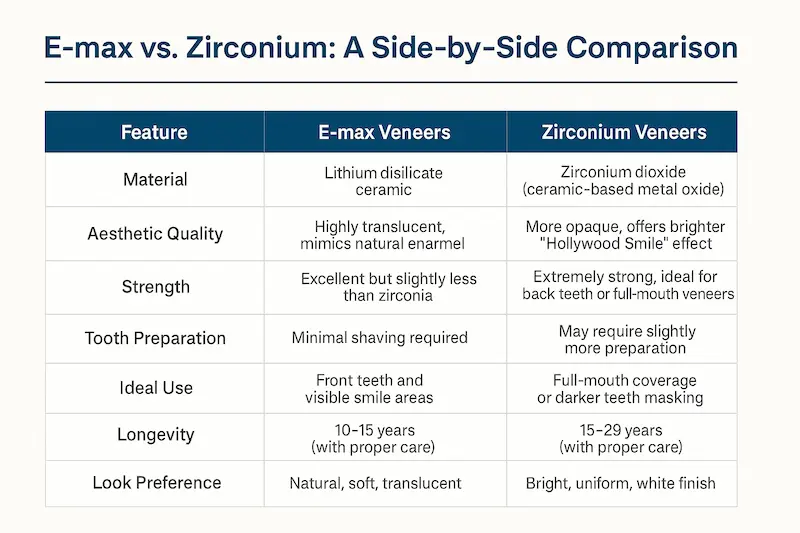
E-max vs. Zirconium Veneers: A Side-by-Side Comparison Table
Before diving into the specifics, let’s explore the key differences between E-max and Zirconium veneers. This overview will help you understand their strengths, limitations, and suitability based on your dental goals.
Aesthetic Appeal & Natural Translucency
The visual appearance is where E-max veneers truly excel. Made from lithium disilicate, they offer exceptional translucency that closely resembles natural enamel. When light passes through E-max, it creates a soft, natural glow—perfect for patients who prefer subtle beauty.
By contrast, Zirconium veneers are slightly more opaque, creating a uniform and vivid white shade. This property makes zirconia ideal for patients who want a flawless, camera-ready “Hollywood Smile.”
In clinical terms, the translucency of E-max allows better blending with natural teeth, while Zirconium provides stronger light reflection—ideal for bright and uniform smiles.
Strength, Durability, and Chip Resistance
If you prioritize strength, zirconia veneers are unmatched. Their high flexural strength (up to 1200 MPa) makes them ideal for patients who grind their teeth or need full-mouth restorations.
However, E-max veneers are also remarkably durable, with a flexural strength of around 400 MPa—sufficient for most cosmetic needs, especially on front teeth.
Dentists often recommend zirconia for molars and E-max for anterior teeth, ensuring the perfect balance of strength and beauty.
Required Tooth Preparation (Minimal vs. Traditional)
Tooth preparation plays a key role in both comfort and long-term dental health. E-max veneers usually require minimal preparation, meaning your natural tooth structure remains mostly intact. This makes them less invasive and ideal for patients with healthy enamel.
Zirconium veneers, on the other hand, may need slightly more tooth reduction due to their thicker structure. However, with the latest CAD/CAM technology, modern zirconia veneers are thinner and more conservative than before, minimizing enamel removal.
Ideal Placement (Front Teeth vs. Full Mouth)
Each material has its ideal placement zone. E-max veneers are perfect for the front teeth, where translucency and realism are critical. They excel in smile design cases where the goal is to enhance brightness without looking artificial.
Zirconium veneers, meanwhile, are recommended for patients seeking a complete smile makeover in Turkey or those with severe discoloration. Their opacity helps mask imperfections, ensuring a consistent look across all teeth.
For many patients, dentists combine both materials strategically—E-max for visible front teeth and zirconium for molars—to achieve optimal function and aesthetics.
The Ultimate Aesthetic Showdown: Natural Look vs. Opaque Brilliance
When comparing zirconia vs. E-max, the real difference often lies in personal taste. E-max provides a natural, slightly warm tone that reflects the characteristics of real enamel, while zirconium delivers a brighter and more luminous effect. Both can be shade-matched to surrounding teeth, but their visual depth varies significantly.
E-max: The Gold Standard for a Natural, Translucent Appearance
Dentists worldwide consider E-max veneers the most advanced solution for patients who prioritize aesthetics. Their ability to reflect light naturally makes them virtually indistinguishable from real teeth. The thin, precise fit also contributes to a seamless smile line without visible transitions between veneers and natural teeth.
E-max veneers are especially popular among professionals, models, and actors who prefer a natural yet camera-ready look. In E-max veneers Turkey clinics, the technology combines digital smile design with artistic craftsmanship for flawless results.
Zirconium: Unmatched for a Bright, Opaque “Hollywood Smile”
When discussing zirconium veneers, the first thing that comes to mind is brilliance. These restorations are known for their ability to create a uniform, bright smile—often referred to as the “Hollywood Smile.” Their slight opacity helps hide underlying discoloration, metal fillings, or irregularities that could otherwise show through thinner materials.
While E-max is known for natural translucency, zirconia veneers excel in achieving a pure white, reflective finish that many patients prefer for aesthetic transformations. Thanks to advancements in dental technology, today’s multilayer zirconia versions combine strength with improved optical properties, allowing them to mimic the natural gradient of real teeth—whiter at the surface, slightly deeper at the base.
Which Material Is Better for Masking Dark or Stained Teeth?
If your natural teeth have dark shades, discoloration, or previous root canal treatments that caused internal staining, zirconium veneers are generally the superior option. Their opacity allows them to mask the underlying color completely, giving a consistent, bright result.
On the other hand, E-max veneers, though more translucent, may allow dark shades to slightly show through. In such cases, dentists sometimes use a special opaque bonding cement to improve the final tone, but the result still might not match zirconia’s masking ability.
Patients with stained, grey, or discolored teeth due to tetracycline, fluorosis, or old metal restorations often choose zirconia veneers Turkey packages because of their predictable color correction.
Color Matching Capabilities of Each Material
Color matching is an essential part of creating a harmonious smile. E-max veneers offer exceptional blending capabilities due to their translucency, which lets the underlying tooth color subtly influence the final shade. This creates a seamless integration with adjacent natural teeth.
Zirconia veneers, being more opaque, rely entirely on their surface shade. While they can’t mimic the natural color depth of E-max, they are ideal for patients seeking a perfectly uniform smile tone—especially in full-mouth cases where all teeth are covered.
In advanced digital veneer studios in Istanbul, dentists use CAD/CAM technology and color-mapping software to determine precise shade gradients. This ensures that whether you choose zirconia or E-max, your final result complements your facial features and skin tone naturally.
Strength & Longevity: Which Veneer Withstands the Test of Time?

Durability is a decisive factor for patients investing in premium veneers. Both materials offer long-term performance when bonded correctly and maintained with proper oral hygiene. However, their resistance levels and lifespans differ slightly.
Zirconium’s Superior Strength: Is It Truly Unbreakable?
Zirconium is one of the strongest materials in modern dentistry, with impressive resistance to cracking, chipping, or wear. It’s widely used for dental crowns, bridges, and even implant frameworks, making it a reliable option for those with high biting forces.
That said, no veneer is entirely unbreakable. Poor oral habits—like biting nails or opening packages with your teeth—can still damage zirconia over time. However, when bonded correctly and maintained properly, zirconia veneers can last 15 to 20 years, often outlasting other materials.
E-max Durability: Strong Enough for Everyday Biting and Chewing?
Despite being thinner and lighter, E-max veneers are remarkably strong for everyday use. They handle regular biting and chewing comfortably, especially when applied to the front teeth. Their molecular structure, based on lithium disilicate, provides the perfect balance between flexibility and hardness.
E-max is less likely to fracture under normal circumstances but is not recommended for heavy bruxism (teeth grinding). In such cases, dentists may advise using night guards to extend the veneer’s lifespan and preserve its glossy surface.
How Grinding Your Teeth (Bruxism) Influences Your Choice
For patients with bruxism or jaw clenching, the decision between E-max vs zirconium veneers becomes even more important. The repetitive grinding motion can wear down or fracture veneers over time. Zirconia veneers, thanks to their high tensile strength, can better withstand this constant pressure.
Dentists in Turkey often recommend a combination approach—zirconia veneers for posterior teeth and E-max for anterior ones—to maintain both strength and natural aesthetics. Additionally, wearing a customized night guard can significantly reduce long-term wear.
Expected Lifespan: How Many Years Do E-max and Zirconium Veneers Last?
The average E-max veneer lasts between 10 and 15 years with proper care, while zirconium veneers can exceed 20 years under ideal conditions. The difference comes mainly from material hardness and resistance to micro-cracks.
Maintenance plays a crucial role in longevity. Regular dental checkups, avoiding very hard foods, and following your dentist’s hygiene instructions ensure both materials maintain their shine and integrity for years.
Many international patients traveling for E-max veneers Turkey treatments appreciate that reputable clinics provide follow-up support and warranty coverage, adding peace of mind to their investment.
The Patient Journey: Tooth Preparation, Comfort, and Biocompatibility
The comfort and compatibility of your veneers depend not only on material selection but also on the treatment process itself. Both E-max and zirconium are biocompatible materials, meaning they do not irritate gums or cause allergic reactions. However, their preparation methods and fitting timelines can differ slightly.
How Much Tooth Shaving Is Required for Each Veneer Type?
E-max veneers usually require less tooth reduction due to their thin structure, often just 0.3–0.5 mm. This preserves natural enamel, reduces sensitivity, and provides a conservative cosmetic solution.
Zirconia veneers tend to be slightly thicker, requiring up to 0.8–1 mm of preparation. However, modern CAD/CAM milling machines used in the best dental clinics in Turkey for veneers make zirconia fittings more precise, allowing for minimal enamel loss.
This gentle approach ensures comfort and prevents post-treatment sensitivity—one of the key concerns among veneer patients.
Biocompatibility: Are Both Materials Safe and Gentle on Your Gums?
Both E-max and Zirconium veneers are highly biocompatible, meaning they integrate well with your natural oral tissues and do not trigger allergic reactions or inflammation. In fact, this is one of the key reasons why they are preferred over metal-based restorations.
E-max veneers are made of lithium disilicate glass-ceramic, a non-metallic and non-reactive compound. Its smooth, glazed surface prevents bacterial accumulation and gum irritation. Similarly, Zirconium veneers (zirconium dioxide) are inert and hypoallergenic. They are especially suitable for patients with sensitive gums or a history of metal allergies.
Dentists in the best dental clinics in Turkey for veneers also emphasize the importance of precise gum line fitting. An accurately contoured veneer edge ensures that the gum tissue remains healthy, preventing redness or receding gums over time. With proper oral hygiene and regular check-ups, both materials maintain their color stability and biocompatibility for years.
The Digital Design and Fitting Process (CAD/CAM)
Modern veneer treatments in Turkey rely heavily on CAD/CAM (Computer-Aided Design and Manufacturing) systems. This technology allows dentists to digitally design each veneer with micron-level accuracy, ensuring a perfect fit and natural alignment with your facial proportions.
The process begins with a 3D intraoral scan, eliminating the need for messy impressions. Digital software then simulates your final smile design before any preparation begins. Both E-max and Zirconium veneers are crafted from high-quality ceramic blocks through computer-controlled milling machines.
For E-max veneers, precision is especially crucial since their thin, translucent structure demands accurate bonding. Zirconium, being denser, is milled slightly thicker, but modern CAD/CAM systems can refine its shape to match individual bite patterns.
This level of customization ensures comfort, proper occlusion (bite), and long-term stability—key components of a functional and aesthetic restoration.
Comparing Treatment Timelines in Turkey
One of the biggest advantages of getting veneers in Turkey is the efficiency of treatment. Dental tourism clinics are equipped with in-house laboratories and CAD/CAM technology, which drastically shortens production time.
Typically, E-max veneers can be completed in 3–5 days, while Zirconium veneers may take around 5–7 days depending on case complexity. Clinics catering to international patients often arrange the process as part of an all-inclusive package—covering accommodation, airport transfers, and language assistance.
This streamlined experience has made E-max veneers Turkey and Zirconium veneers Turkey some of the most sought-after aesthetic treatments for patients from the UK, Europe, and the Middle East seeking both quality and convenience.
Cost Analysis: Is E-max Worth the Premium Price in Turkey?
The cost of veneers in Turkey is one of the main reasons the country has become a global hub for cosmetic dentistry. Patients can achieve world-class results for a fraction of what they’d pay in Western Europe or the United States. However, the price of E-max vs Zirconium veneers depends on various factors such as material, technology used, and dentist expertise.
A Detailed Breakdown of E-max Veneer Costs
E-max veneers are considered a premium option due to their high aesthetic value and complex manufacturing process. They require more delicate handling, customized layering, and expert craftsmanship to ensure natural translucency.
Their higher price reflects these features, but patients often view it as a worthwhile investment in smile aesthetics. Since E-max veneers typically require less tooth reduction, they also help preserve natural enamel—an added benefit for long-term dental health.
If you are considering E-max veneers in Istanbul, the final cost may vary depending on the number of veneers, laboratory quality, and whether the treatment includes digital smile design or additional services. For an exact price, you can contact our clinic directly for a personalized quote.
Zirconium Veneers: The Cost-Effective Path to a Strong Smile
For patients prioritizing strength, zirconium veneers provide exceptional value. They are slightly more affordable than E-max veneers while offering superior durability. Zirconia’s manufacturing process is simpler, and since it can be produced in multiple layers, it often requires fewer adjustments during fitting.
Despite the lower price, zirconium veneers are still a premium, long-lasting option—especially for full-mouth restorations or patients who clench or grind their teeth. The slight savings compared to E-max make zirconia a popular choice among those seeking a complete Hollywood Smile Turkey transformation at a balanced cost.
What Is Included in a Typical Veneer Package Price?
Most veneers Turkey price packages are designed to offer a complete, stress-free experience for international patients. These usually include:
- Initial dental consultation and digital smile design
- Panoramic X-rays and intraoral scans
- Tooth preparation and temporary veneers
- Final E-max or Zirconium veneer application
- Follow-up checks and bite adjustments
- Hotel accommodation and VIP airport transfers
This all-inclusive structure ensures both cost transparency and comfort, allowing patients to focus entirely on their treatment journey.
Evaluating Long-Term Value vs. Upfront Cost
While E-max veneers have a higher initial cost, their ability to mimic natural teeth and require minimal shaving makes them valuable long-term. They blend flawlessly and maintain color stability for over a decade, making them a favorite among those who prioritize subtle aesthetics.
Zirconium veneers, in contrast, offer unmatched strength and resilience, especially for patients who prefer a bright, uniform appearance or who have functional concerns like bruxism. Their durability often results in lower maintenance costs over time.
Ultimately, the real value lies not only in material choice but also in the dentist’s precision, the lab quality, and post-treatment care. In Turkey, many clinics achieve this balance by combining advanced technology with internationally accredited dental specialists.
The Final Verdict: How to Choose the Perfect Veneer for Your Smile
Selecting between E-max vs Zirconium veneers is not simply a matter of price or preference—it’s about harmonizing aesthetic goals with functional needs. Both materials represent the pinnacle of modern cosmetic dentistry, but the right choice depends on your oral structure, the color of your natural teeth, your bite force, and how natural or “Hollywood” you want your smile to look.
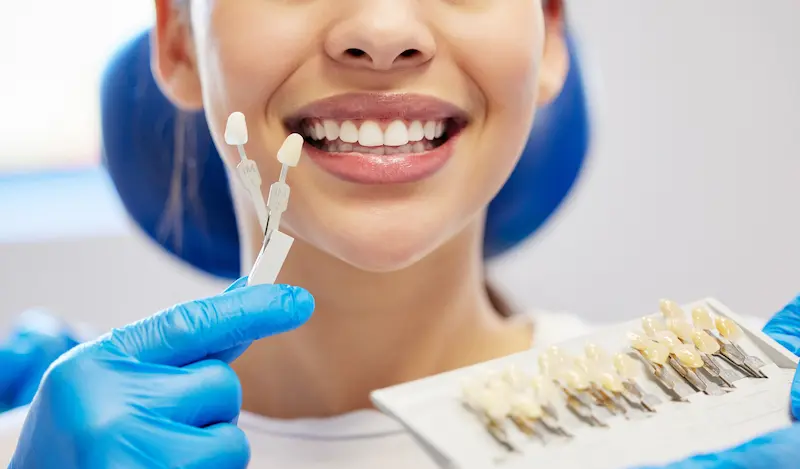
During consultation, your dentist evaluates enamel condition, gum health, tooth alignment, and even facial proportions before making a recommendation. The artistry and clinical experience behind the treatment often matter just as much as the material itself.
Choose E-max If Your Priority Is the Most Natural Look
If you desire a smile that is virtually indistinguishable from natural enamel, E-max veneers are the gold standard. Their light-transmitting properties allow a perfect balance between brightness and realism. This makes them especially ideal for front teeth—where every detail of reflection and translucency affects the overall appearance.
Moreover, because E-max veneers require minimal tooth reduction, they are gentle on natural enamel. The thin structure also provides a comfortable fit and natural gum transition, which makes them suitable for patients with high aesthetic expectations but healthy teeth.
Clinics offering E-max veneers Turkey treatments often combine digital smile design with high-resolution 3D imaging. This ensures that every angle, contour, and tooth shape complements your facial features, creating a refined and confident result.
Choose Zirconium If You Need Maximum Strength or Want to Cover Dark Teeth
Patients with darker or damaged teeth, or those seeking a striking white smile, often prefer Zirconium veneers. Their strong opacity effectively conceals underlying imperfections such as root discoloration, metal fillings, or tetracycline stains.
In terms of functionality, Zirconium veneers are unmatched in strength, making them ideal for patients who grind their teeth or require full-mouth reconstruction. They resist chipping and wear, providing a brilliant smile that endures heavy biting pressure for years.
For those wanting a complete Hollywood Smile makeover in Turkey, zirconium veneers are often the material of choice because of their ability to deliver that iconic, uniform brightness associated with celebrity smiles.
Can You Mix E-max and Zirconium Veneers in the Same Smile?
Yes, many dentists recommend a hybrid approach for optimal aesthetics and strength. It’s quite common for E-max veneers to be used on the front six teeth (upper and lower), while zirconium veneers are applied to the premolars and molars.
This combination offers the best of both worlds—the lifelike translucency of E-max in visible areas and the durability of zirconium in the back where biting pressure is strongest. The result is a smile that looks natural yet performs reliably under daily function.
In advanced clinics, CAD/CAM systems and digital smile simulations allow patients to visualize this combination before treatment begins, ensuring both aesthetic satisfaction and practical longevity.
The Critical Role of Your Dentist’s Recommendation
No matter how well-informed a patient is, the final decision should always be guided by a qualified dentist. An experienced cosmetic dentist understands the unique properties of E-max vs zirconium veneers and how they interact with your specific dental anatomy.
For instance, even if a patient desires the translucent beauty of E-max, the dentist might recommend zirconia if their teeth are heavily stained or structurally weak. Conversely, a patient requesting bright zirconium veneers may benefit more from E-max if their enamel tone is already light and uniform.
The key lies in trust and professional evaluation. At the best dental clinics in Turkey for veneers, your treatment plan is customized through a detailed examination, digital scans, and a full smile design consultation. This ensures that the final result matches your goals in both aesthetics and comfort.
Additional Considerations: Aftercare and Maintenance
Regardless of which material you choose, proper care determines how long your veneers will last. Brushing twice daily with a soft-bristled toothbrush, flossing carefully, and avoiding excessive force when biting hard foods will significantly extend their lifespan.
Regular check-ups—especially after veneer placement—allow your dentist to polish, adjust, or professionally clean the veneers to maintain their luster. Patients who grind their teeth should use custom-made night guards to prevent pressure damage.
With the right care, E-max veneers can last 10–15 years, and Zirconium veneers up to 20 years or more—making both excellent long-term investments in your smile and self-confidence.
Frequently Asked Questions:
Which looks more natural — E-max or zirconia?
E-max. Its lithium-disilicate glass-ceramic has lifelike translucency that mimics enamel, making it ideal for natural-looking front teeth.
Is E-max stronger than zirconia?
No. Zirconia is the stronger material and resists high bite forces better, especially in posterior teeth and full-mouth cases.
What is the best material for dental veneers?
Best material for dental veneers depends on goals. Choose E-max for maximum aesthetics and minimal prep; choose zirconia for strength, masking dark teeth, or bruxism.
What’s the best veneers for front teeth material?
E-max typically wins because its translucency and edge detail blend seamlessly with adjacent natural teeth.
Which veneers are most chip resistant?
Zirconia offers superior chip and fracture resistance; E-max is durable for daily use but less tough under heavy grinding without a night guard.
Are these biocompatible dental materials safe for gums?
Both E-max and zirconia are metal-free, hypoallergenic, and gum-friendly. Proper margins and polishing further reduce plaque retention and irritation.